



ControTrace®
ControTrace®

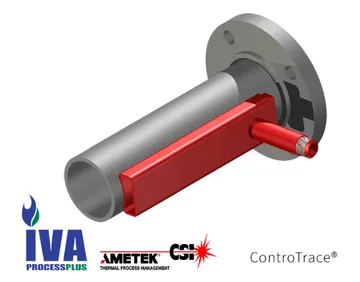
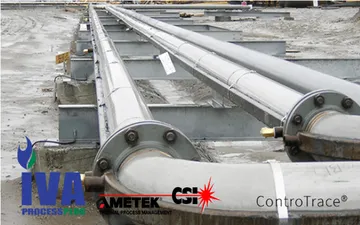
The basic configuration of a ControTrace® heat tracing element is a 2-in. by 1-in. rectangular tube formed of SA178 Grade A boiler tubing. One of the 2-in. sides is contoured to closely fit the outside diameter of the pipe or vessel onto which it will be placed. The ControTrace® elements are design to ensure ample robustness and pressure-containing capability. These heating elements can be rated for higher pressure steam as well. Individual elements are fabricated to specific lengths. The ends of the tubing are closed (seal welded), and inlet and outlet connections are added to enable heating medium transfer. When multiple elements are required, these are most often joined together in panel configuration to minimize the number of inlet/outlet connections. ControTrace® is secured to the pipe or vessel with high-strength banding (no welding is required). Before banding, a thin layer of heat transfer compound is spread onto the surface that will be in contact with the pipe or vessel.
During operating, the heating medium (typically steam or heating fluid) flows through the heating element and transfers its heat through the heat transfer compound and into the pipe/vessel wall and into process. The number of heating elements required depends upon the design objective and the design conditions. Most ControTrace® applications are designed to maintain a process temperature (to keep liquid flowing) or a minimum pip/vessel wall temperature (to prevent vapor condensation). CSI utilizes finite-difference computer modeling to simulate and predict temperature profiles and heat transfer rates based upon process, ambient, piping, and insulation conditions. The computer model has been corroborated time and again with empirical field data.